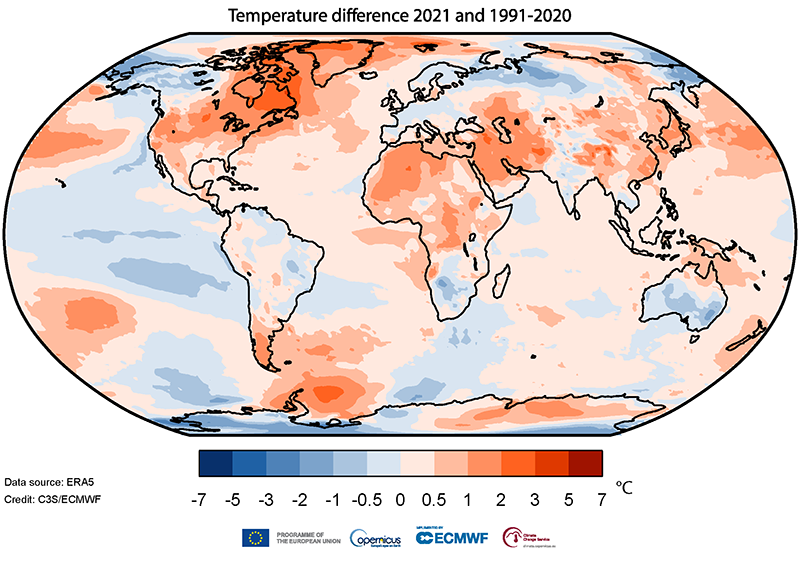
The EU Copernicus Climate Change Service's released its annual findings for 2021
In conjunction with the Copernicus Atmosphere Monitoring Service (CAMS), C3S reports that preliminary analysis of satellite measurements confirm that atmospheric greenhouse gas concentrations continued to rise during 2021. For the year as a whole, in 2021 Europe was just 0.1 °C above the 1991-2020 average, which ranks outside the ten warmest years. The ten warmest years for Europe have all occurred since 2000, with the seven warmest years being 2014-2020.
Several high-impact extreme events happened during summer 2021 in Europe. July saw a very heavy rainfall event in western central Europe in a region with soils close to saturation, leading to severe floods in several countries, with the most heavily impacted including Germany, Belgium, Luxembourg, and the Netherlands. The Mediterranean region experienced a heatwave during July and part of August, with high temperatures particularly affecting Greece, Spain, and Italy. Hot and dry conditions preceded intense and prolonged wildfires, particularly in the eastern and central Mediterranean with Turkey being one of the most impacted countries, in addition to Greece, Italy, Spain, Portugal, Albania, North Macedonia, Algeria, and Tunisia.
Mauro Facchini, Head of Earth Observation at the Directorate General for Defence Industry and Space, European Commission, comments: "Europe's commitment to respond to the Paris agreement can only be achieved through effective analysis of climate information. The Copernicus Climate Change Service provides an essential global resource through operational, high-quality information about the state of our climate that is instrumental for both climate mitigation and adaptation policies. The 2021 analysis, showing that globally the warmest years by far were recorded in the last seven years, is a reminder of the continued increase in global temperatures and the urgent necessity to act."
C3S will comprehensively review different 2021 climate events in Europe in its annual European State of the Climate, due to be published in April 2022.
The Copernicus Climate Change Service (C3S) is implemented by the European Centre for Medium-Range Weather Forecasts (ECMWF) on behalf of the European Commission with funding from the European Union.
Link: https://climate.copernicus.eu/copernicus-globally-seven-hottest-years-record-were-last-seven