The 2021 Epidemic Intelligence from Open Sources (EIOS) Global Technical Meeting (GTM): Together for Zero Impact from Health Threats
"Collaboration is not some nice to have thing that we may or may not want to do: it is an existential necessity if we really want to keep this world safe" summarized Chikwe Ihekweazu as the main take away of the third EIOS Global Technical Meeting (GTM), which took place from 6-10 December 2021. As the new Assistant Director General (ADG) of the World Health Organization (WHO), Ihekweazu is leading the recently launched WHO Hub for Pandemic and Epidemic Intelligence, of which the Epidemic Intelligence from Open Sources initiative (EIOS) will form an integral part.
Pre-dating and in line with the Hub's vision of global collaboration for "better data, better insights and better decisions" when it comes to health emergencies, the EIOS GTM is the initiative's key annual event since 2018. In the spirit of EIOS, a global collaborative of multi-disciplinary experts focusing on issues of Public Health Intelligence (PHI), the GTM aims to bring these experts together once a year to further strengthen existing networks, build new alliances as well as to discuss topical challenges, solutions, and innovations in the field.
After a hiatus in 2020 due to the emergence of SARS-CoV-2, the 2021 GTM was held virtually and explored from multiple perspectives how the COVID-19 pandemic had impacted the Public Health Intelligence function. Under the slogan "Together for Zero Impact from Health Threats", referring to the EIOS initiative's vision, the event was attended live by 374 participants from more than 80 different countries. Meeting attendees were comprised of multidisciplinary experts from government and academic institutions, NGOs, UN agencies, as well as the private sector, overall representing over 70 different entities.
The ability to convene communities from around the world, working together under a common mission of "making the world a safer place through public health intelligence" was also recognized by Mike Ryan, Executive Director of WHO's Emergencies Programme. In his welcome address to participants, he called EIOS "one of WHO's flagship initiatives [that] has stimulated innovative research and development through collaborations across sectors, disciplines, and jurisdictions."
Like the successful 2019 event that took place in Seoul, Republic of Korea, the 2021 agenda was almost entirely driven by the growing community behind the EIOS initiative. More than 80 speakers contributed to 18 live sessions over the five conference days.
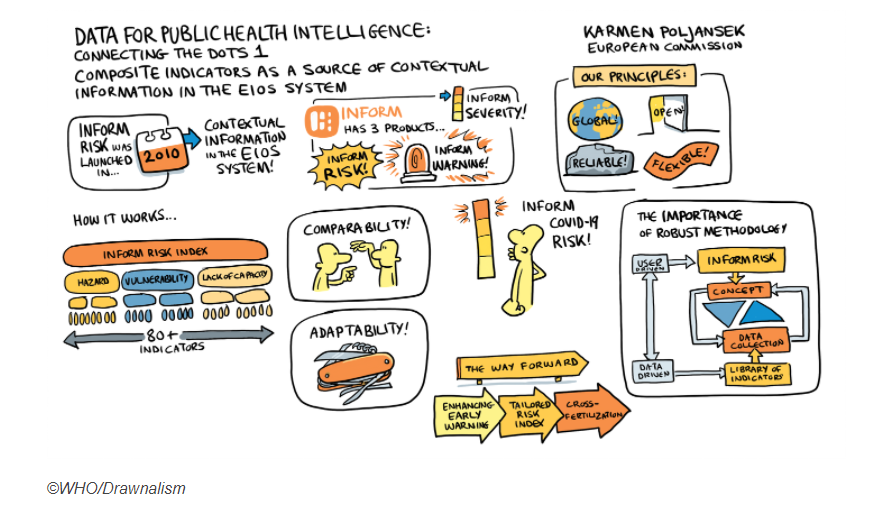
The Joint Research Center was represented with several presentations in sessions related to "Data for Public Health Intelligence – Connecting the Dots" and "Insights from Data - Navigating the Infodemic." They updated GTM participants on composite indicators as a source of contextual information in the EIOS system, as well as on ongoing work and research in Natural Language Processing and trend analysis of COIVD-19 disinformation.
Live illustrations of the GTM sessions, as well as two live poetry performances dedicated to the work and experience of Public Health Intelligence experts added an artistic component to the event, which was particularly appreciated by participants. "As a scientist I have found that Arts and culture are an untapped resource that can strengthen our work. It was great to see this [poetry] session at the GTM," says Peter Babigumira Ahabwe, Technical Advisor at the Uganda Public Health Emergency Operations Center. He adds that the GTM was an important event because it provided a platform and forum for dialogue.
More information about the 2021 EIOS GTM, more visuals and access to session recordings will soon be available for on-demand view on the EIOS website under www.who.int/eios.
Link: www.who.int/eios