The Science behind the EU’s response to the earthquakes in Türkiye and Syria
The European Commission’s Joint Research Centre (JRC) and the Emergency Response Coordination Centre (ERCC) have supported decision-making at political and ground levels since day one by providing an integrated scientific perspective and updated information.
Thirty-two minutes after the first earthquake, the Global Disaster Alert and Coordination System released a red alert, indicating the need for international assistance to cope with a major disaster. Türkiye contacted the ERCC, which then activated the Union Civil Protection Mechanism and Copernicus Emergency Management Service (CEMS) and requested Urban Search and Rescue teams. The ERCC highlighted the needs, based on which the JRC’s Disaster Risk Management team produced several emergency reports.
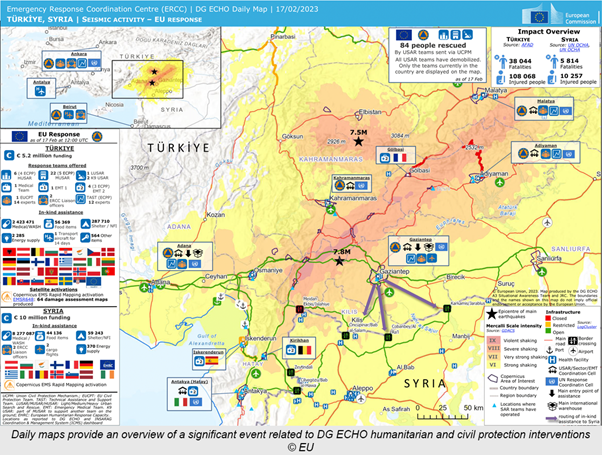
Later, ECHO Daily Maps (see image) were developed to inform about the impact and response to the event, based on needs highlighted by the ERCC.
These reports highlighted potential or existing damage to the built environment, dam breaking, migration consequences, misinformation trends, and health situations in the affected areas. The reports also featured work by the Social Media for Disaster Risk Management (SMDRM) AI algorithm, which processed more than a million Twitter messages to identify those requesting help. Less than 48 hours later, CEMS delivered the first maps of the event, identifying the affected infrastructure, flood-prone areas, and the location of humanitarian camps.
Less than 48h CEMS started delivering the first maps of the event, identifying the infrastructure - buildings, dams or gas or oil pipelines - affected. Other maps showed the situation in flood-prone areas or the location of humanitarian camps.
Additionally, the CEMS Drought Observatory reported that Türkiye and the Maghreb region are under warning drought conditions, which may worsen water availability for agriculture and energy. The JRC continues to provide science-based evidence to support European Commission efforts and contributions to this emergency.